

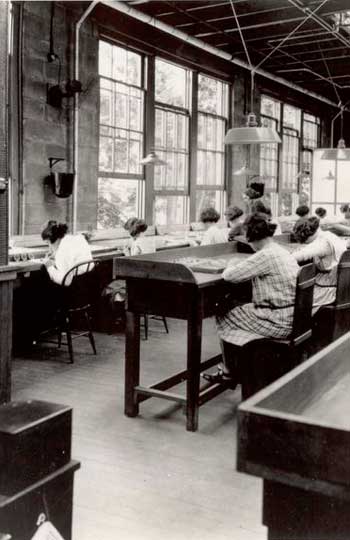
In the 1920s, the particularly tragic case of the ‘radium girls’ caused widespread concern.
The subsequent legal and media battle led to a significant increase in awareness of occupational risks and illnesses. This has contributed to the strengthening of the legal framework for the protection of employees.
The subject of the controversy
The luminescence of a watch dial’s components has been a key consideration since the dawn of watchmaking. It is vital that the markings can be read clearly in low-light conditions. Diving watches must possess this essential feature on the hands, bezel and dial. At the time, the only known and used material was radium. Radium, a highly radioactive substance, was applied in paste form to the components.
Fatal consequences
The women workers, whose job it was to apply the luminescent material to the watch components, used a technique known as ‘lip, dip, paint’. The artisans would wet the brush with their lips to create a fine tip, dip the brush into the paint, and then apply the numerals to the dials.
It was soon apparent that a number of employees were experiencing health issues, including tumours. It is a matter of concern that many of the female workers died as a result of two key factors. Firstly, they were exposed to the material through direct skin contact. Secondly, they inadvertently ingested radioactive material.
It will later become apparent that those in charge were aware of the danger, yet allowed these women to carry out this dangerous task.
A legal and media battle
The Radium Girls initiated legal proceedings against the responsible companies, notably the United States Radium Corporation, in an effort to assert their rights. The case attracted national attention and sympathy during a lengthy legal battle. In the end, the victims were successful in some of their cases. This case has had a significant impact on safety standards across various industries, leading to a greater recognition of occupational diseases.
Reforms relating to worker protection
The Radium Girls case had a significant impact on labour regulations, particularly with regard to the handling of hazardous substances. The initiative also served to raise public awareness of the dangers of radioactivity, leading to reforms designed to protect workers and establishing stricter workplace safety standards.

